
Skip to content

Satyam Bora

hyderabad, in

Satyam Bora

Software engineer, Hyderabad

I build software you’ve been meaning to build.

Custom applications, workflow automation and AI — for businesses that have outgrown spreadsheets, and for founders who need a product built.

Four years building B2B software. Most recently CollabIQ, a platform I designed, built and shipped solo — live and in use today.

Satyam Bora, a software engineer, photographed from the shoulders up against a plain background.

Who I work with

Agencies and B2B service businesses

Client reporting, project intake, onboarding, invoicing and follow-ups are where service businesses quietly lose margin. Every hour spent assembling a monthly client report is an hour nobody is paying for. I build the systems that do that work automatically — pulling from the platforms you already use and producing the reports, dashboards and reminders your team currently produces by hand.

Founders who need a product built

You have a product in your head and no engineering team. I take it from spec to a deployed, working application — frontend, backend, database, infrastructure — typically in 6 to 8 weeks, at a fixed price agreed before we start.

Businesses drowning in manual work

A process that eats hours every week — reports assembled by hand, data copied between systems, information living in one person’s spreadsheet. I map it, automate what should be automated, and build the small amount of custom software that fills the gaps.

Established businesses going digital

Paper forms, WhatsApp and a shared drive got you here, and now they’re the ceiling. I build the internal tools that replace them — job tracking, customer records, scheduling, approvals — designed around how your team already works.

What I build

Connecting the systems you already use so data moves without anyone copying it: automated reports, alerts, follow-ups, and scheduled jobs that run whether or not someone remembers.

Extracting structured data from documents and invoices, triaging inbound enquiries, and search across internal documents in plain language — built as real features with sensible fallbacks and controlled costs.

Dashboards, admin systems, CRMs and tracking tools built around your actual process, for the cases where no product on the market fits how you work.

Aggregation pipelines, dashboards and exportable client-facing reports. I’ve built exactly this twice: retail analytics at NCR Corporation, creator analytics at CollabIQ.

Full MVPs from spec to launch, for founders and for businesses launching something new.

Case study

CollabIQ

Replacing hours of manual reporting with data that updates itself. Solo build — design, architecture, frontend, backend, infrastructure. Live with early users.
View the live product

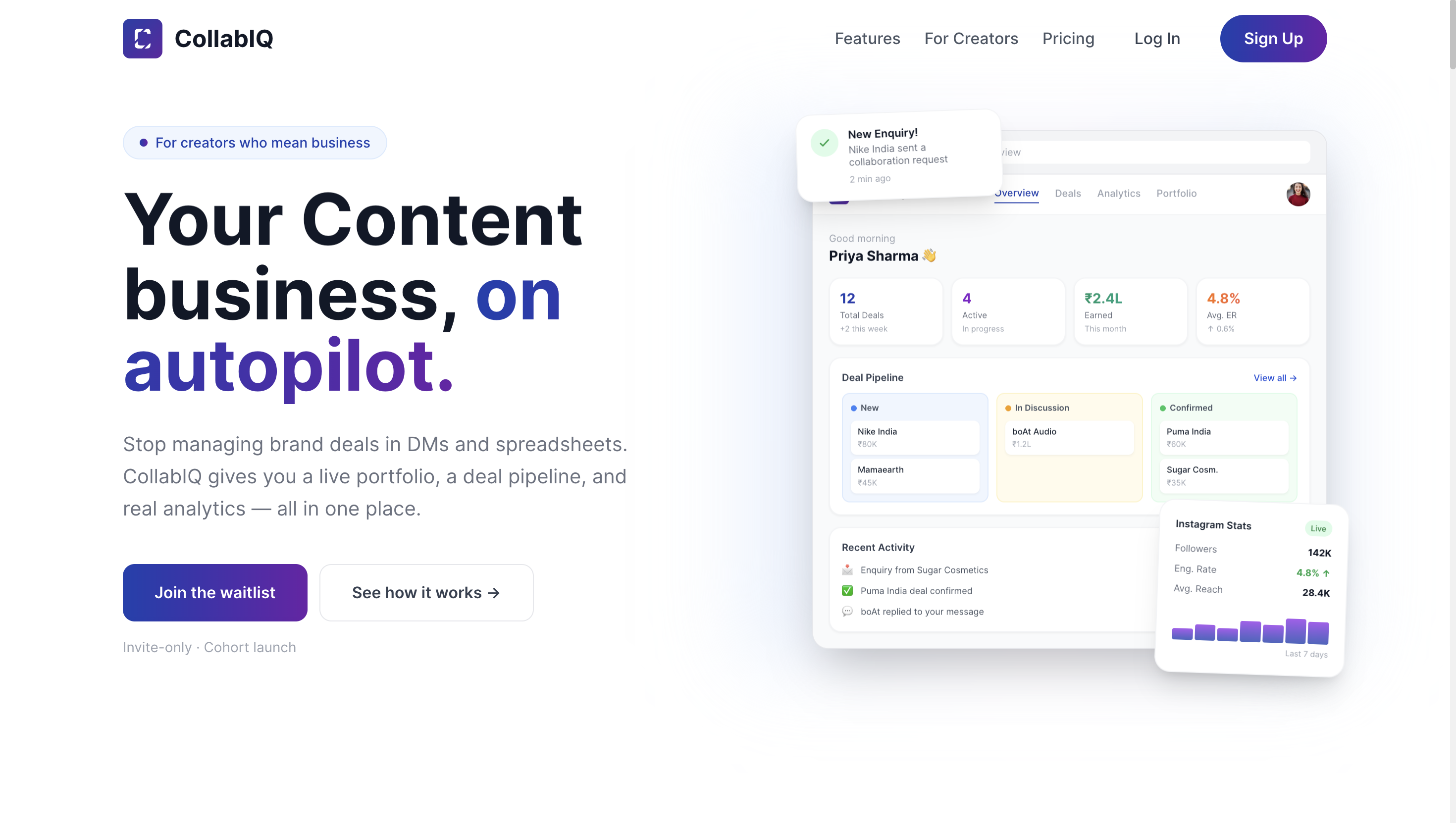
  • The CollabIQ landing page: the headline “Your Content business, on autopilot”, a line about replacing brand deals run out of DMs and spreadsheets, and a waitlist call to action, beside a preview of the dashboard showing deal counts, earnings, a deal pipeline and live Instagram stats.
    The landing page, pitching a live portfolio, deal pipeline and analytics in one place.
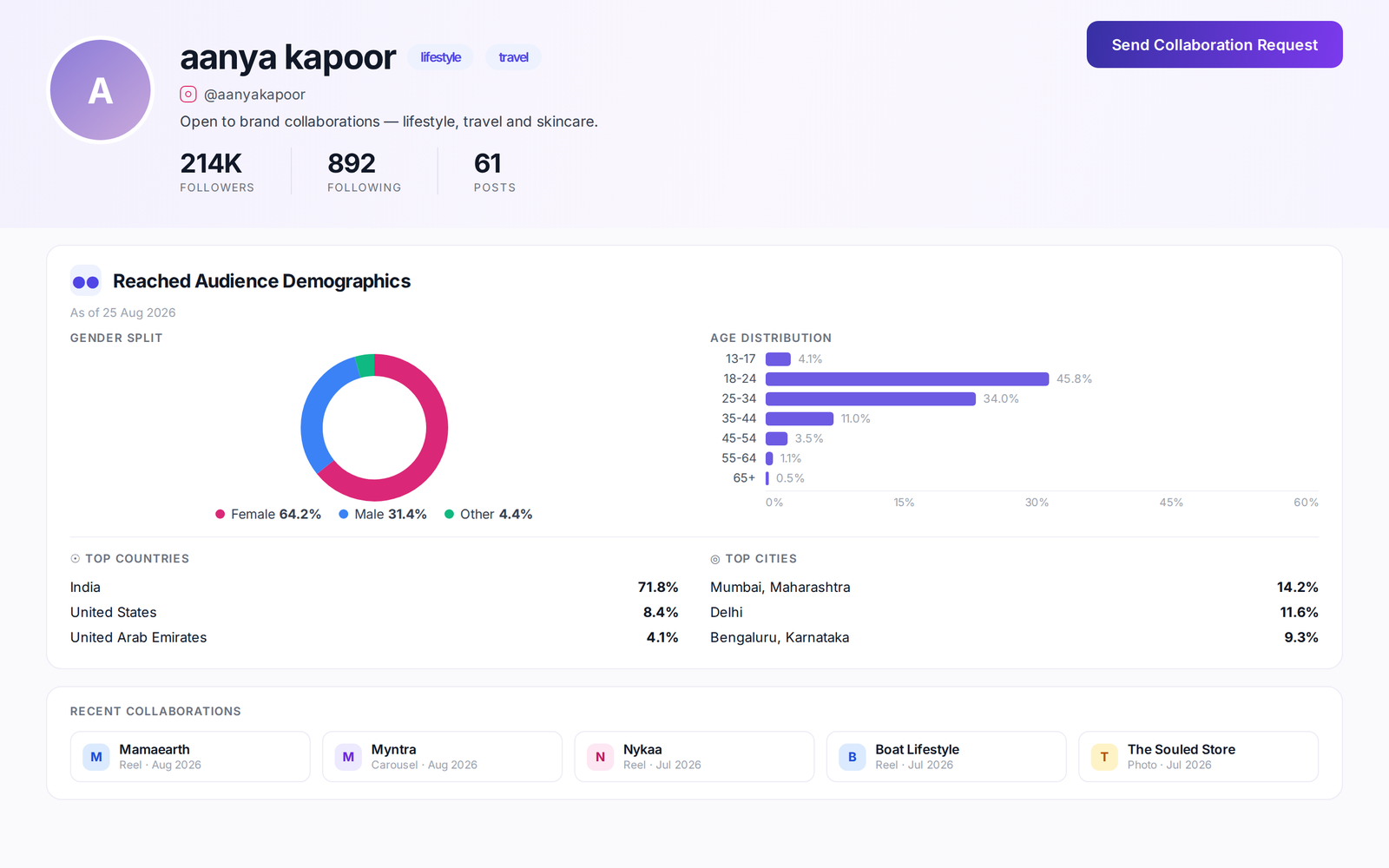
  • A creator’s public CollabIQ portfolio: follower, following and post counts across the top, then reached-audience demographics with a gender split, an age distribution chart, top countries and cities, and a row of recent brand collaborations.
    The public portfolio, pulling live Instagram performance and audience data.
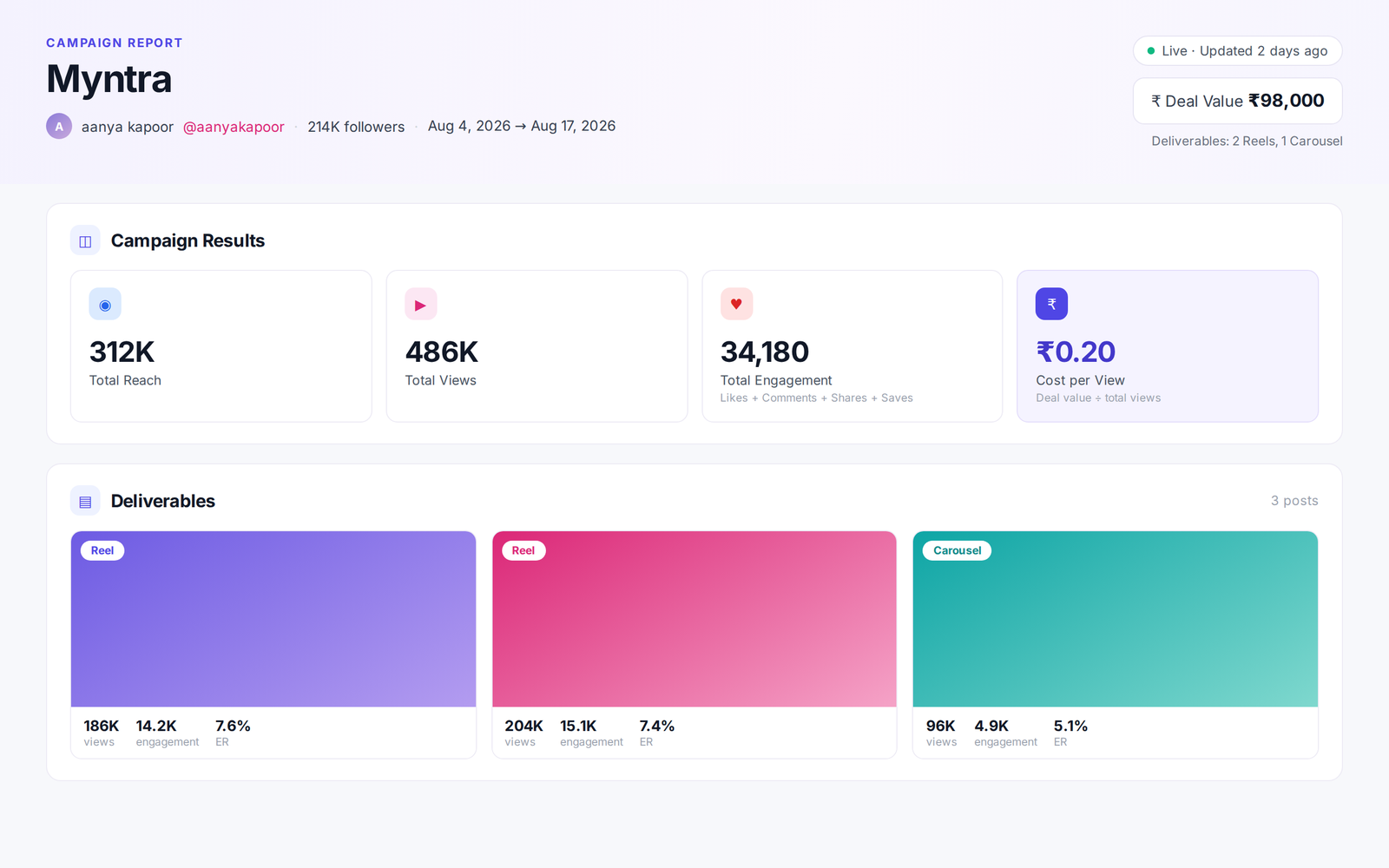
  • A generated campaign report for a Myntra collaboration, showing deal value, total reach, views, engagement and cost per view, with each delivered Reel and Carousel listed underneath with its own views, engagement and engagement rate.
    A brand performance report, generated from campaign data.
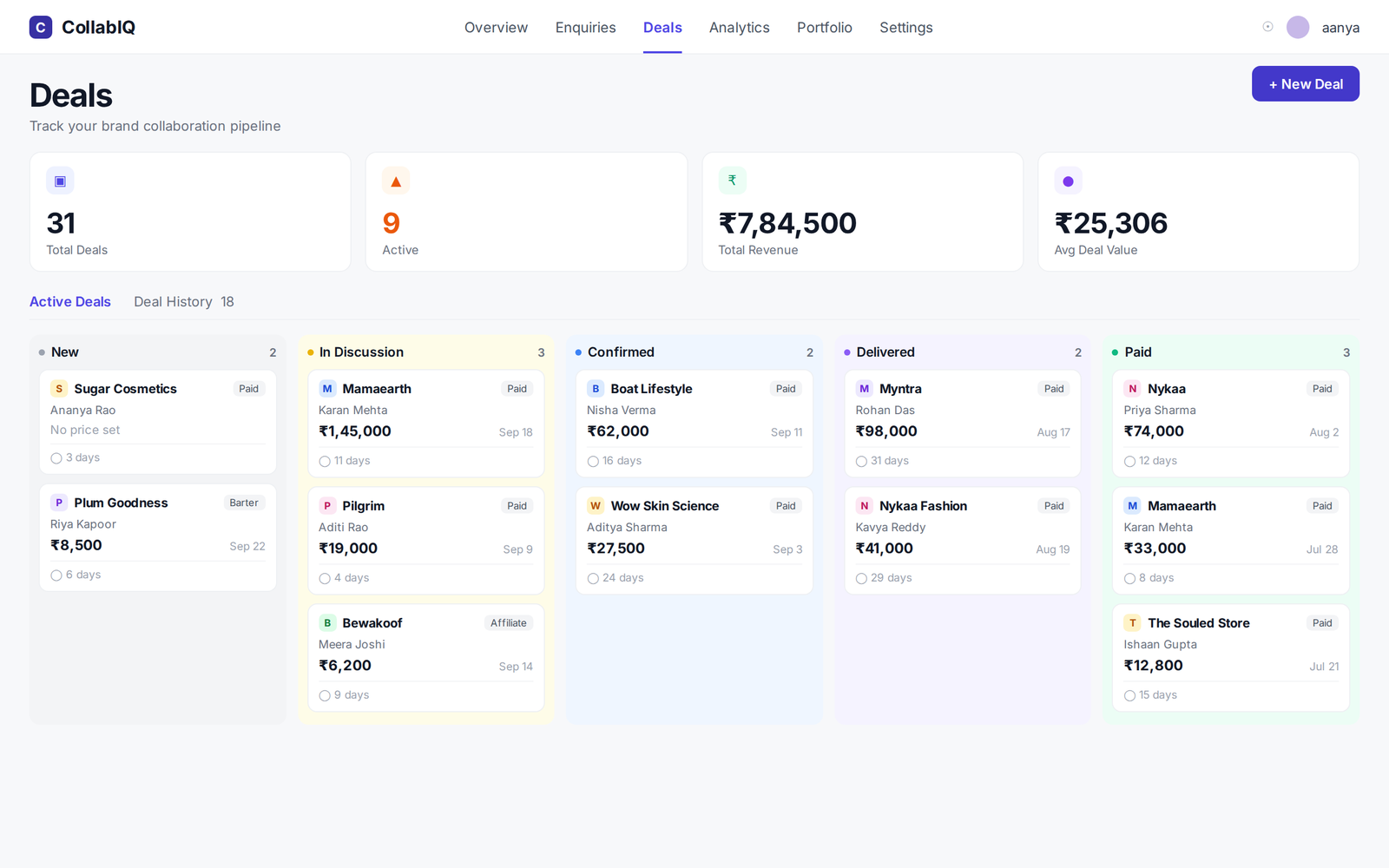
  • The CollabIQ deals board: brand collaborations moving through New, In Discussion, Confirmed, Delivered and Paid columns, each card showing the brand, the contact, the agreed fee and how many days it has sat in that stage.
    The enquiry pipeline, with reminders on stalled deals.
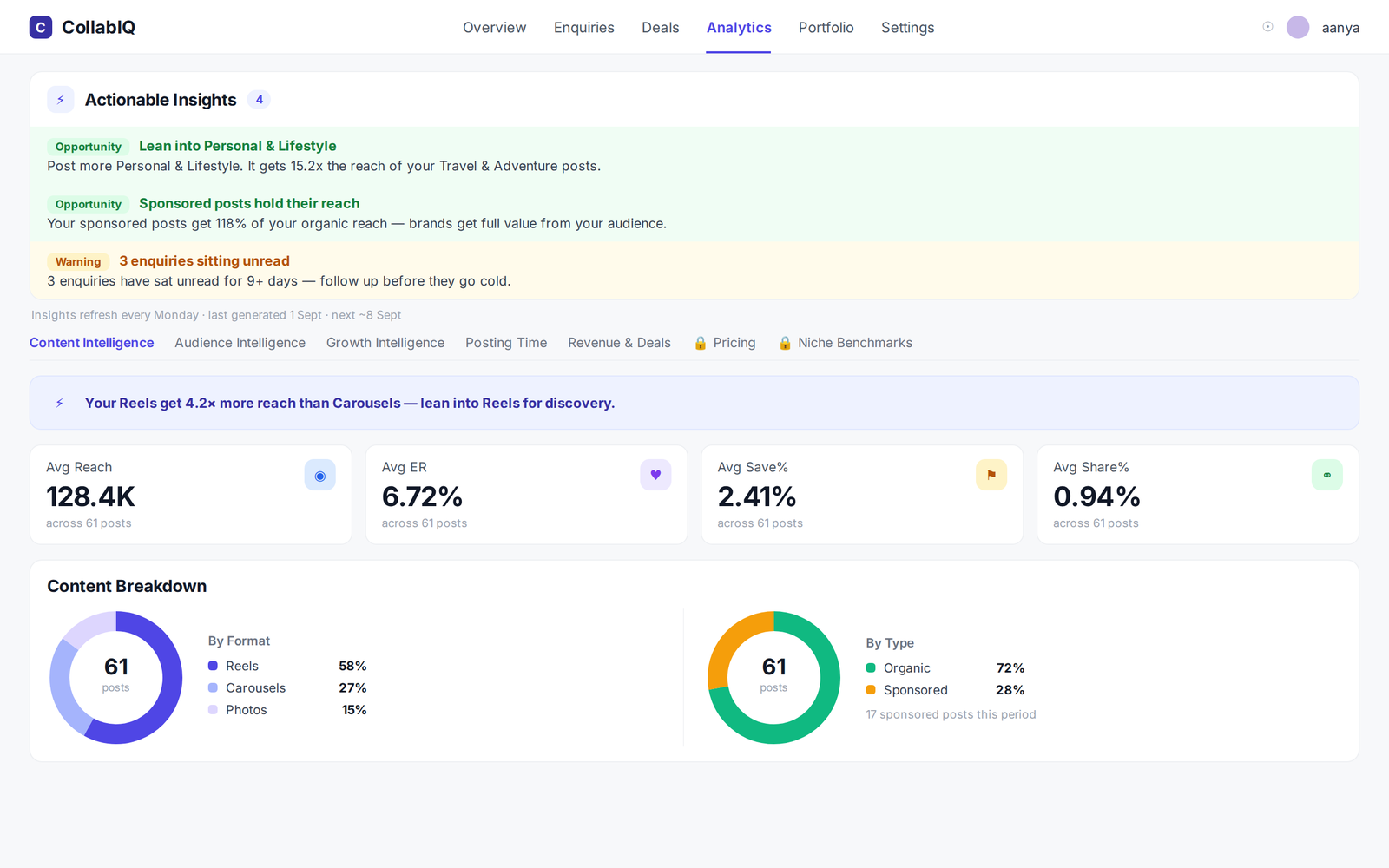
  • The CollabIQ analytics view: AI-generated actionable insights flagging opportunities and an unread-enquiry warning, average reach, engagement, save and share rates across 61 posts, and a content breakdown by format and by organic versus sponsored.
    Analytics and pricing guidance in a single view.

The problem

Content creators run real businesses on almost no tooling, and the cost is entirely manual work.

Every brand deal means screenshotting analytics from several platforms and assembling a performance report by hand. Media kits go stale within weeks of being made. Enquiries arrive scattered across Instagram DMs, email and WhatsApp, so deals get forgotten and invoices go uncollected.

None of it is difficult work. All of it is repeated work — hours per deal, plus revenue leaking through follow-ups that never happened.

What I built

Portfolios that update themselves

A public portfolio that pulls live performance data from connected platforms. It never goes stale, because nobody maintains it.

Reports that generate themselves

Performance reports for brand partners built automatically from live campaign data, replacing the manual screenshot-and-format cycle on every deal.

One place for enquiries

An enquiry form feeding a purpose-built CRM. Deals move through stages with automated reminders for follow-ups and payments, so nothing is lost between the first message and the invoice being paid.

Analytics and pricing intelligence

Content and business performance in one view, with AI-generated insights, benchmarking and pricing guidance.

The engineering

OAuth through the Instagram Login API, token refresh, rate limiting and scheduled re-pulls of profile, media and demographics data against the Meta Graph API. Building an integration that keeps working without anyone intervening is most of the work, and almost none of it is visible from the outside.
Every data pull, refresh, analytics computation and outbound email runs through BullMQ queues on a separate worker service, with concurrency tuned per queue so a slow Instagram refresh never blocks a time-critical job. Metrics land in Postgres through Drizzle, behind a transaction-mode connection pooler with a hard cap on connections per process.
Content analysis and suggestions run on Claude Haiku, chosen because the job is high-volume and latency-sensitive rather than hard. Model output has to be grounded in the user’s real numbers and returned in a shape the interface can render: constrained outputs, validation, and graceful degradation when the model returns something unexpected.
Next.js on Vercel, the worker on Railway, Postgres on Supabase, Redis on Upstash. Instrumented with Sentry, Axiom and PostHog so problems surface before users report them. Every one of those is a cost decision a pre-revenue product actually has to make.

Why this is relevant to you

The specific business is creators. The underlying problem is not: data trapped in multiple systems, reports assembled by hand, enquiries lost across channels, follow-ups depending on someone’s memory.

That’s the same problem an agency has with client reporting, a service business has with intake and invoicing, and a traditional business has with a process running on spreadsheets and email.

Built with Next.js and TypeScript on Vercel, a BullMQ worker on Railway, Postgres on Supabase via Drizzle, Redis on Upstash, and the Claude API.

Before that

Software engineer, NCR Corporation — three years

I worked on a B2B analytics product used by retail businesses to understand inventory, product adoption and sales performance — turning large volumes of transactional data into something a store manager could act on in under a minute. Three years shipping to paying enterprise customers, inside a real release process, with real consequences for breaking things.

How we’d start

Two ways in, depending on what you already know about the problem.

If you know something’s wasting time but not what to fix

A workflow audit, over two to three days. I go through how your team actually works, identify what’s costing hours, quantify it, and come back with a prioritised plan and a fixed quote for each piece. You get a written document you own regardless of whether you hire me for the build. Roughly half of these turn into projects; the other half get a clear plan and go do it themselves, which is a fine outcome.

If you know what you want built

A discovery week. We work through requirements in detail, I produce a written specification with wireframes, and you get a fixed quote for the build. Then we build.

How I run projects

  • Fixed priceagreed before we start, so there are no hourly invoices to audit.
  • Milestone paymentssplit across kickoff, midpoint and delivery.
  • Changes are quoted, not absorbedanything outside the agreed spec gets its own small estimate, which keeps the original timeline honest.
  • Weekly written updateswhat shipped, what’s next, anything I’m blocked on. You never have to ask.
  • You own everythingcode, infrastructure and accounts in your name from day one. Handover includes documentation and a walkthrough.
  • Support after launchan optional monthly retainer for maintenance, fixes and small changes. Most clients want it; nobody is obliged to take it.

Toolkit

Building
Next.js, React, TypeScript, Node.js, PostgreSQL, Drizzle ORM
Integration
Third-party APIs, OAuth, webhooks, job queues (BullMQ), data pipelines
AI
Claude API, structured extraction, document processing, retrieval
Infrastructure
Vercel, Railway, Supabase, AWS, Redis, CI/CD, monitoring with Sentry and PostHog

About

Satyam Bora, a software engineer, photographed from the shoulders up against a plain background.

I’m a software engineer based in Hyderabad, India. I work remotely with clients across timezones, with overlap for US and European mornings.

Computer Science at VIT Vellore, then three years building B2B analytics software at NCR Corporation, then I built and launched my own product. That last part is the reason I’m useful to businesses rather than just to engineering teams: I’ve had to decide what’s worth building and what isn’t, under real constraints, with my own money.

Most of what I do comes down to the same thing — finding the work a person is doing that a computer should be doing instead.

I take on a small number of projects at a time.

Tell me what’s taking up too much time, or what you’re trying to build.

I’ll reply within a day, and I’ll tell you honestly if I’m not the right fit — including if what you need is a tool you can buy rather than something I should build.

Currently taking on new projects.